

Table of Contents
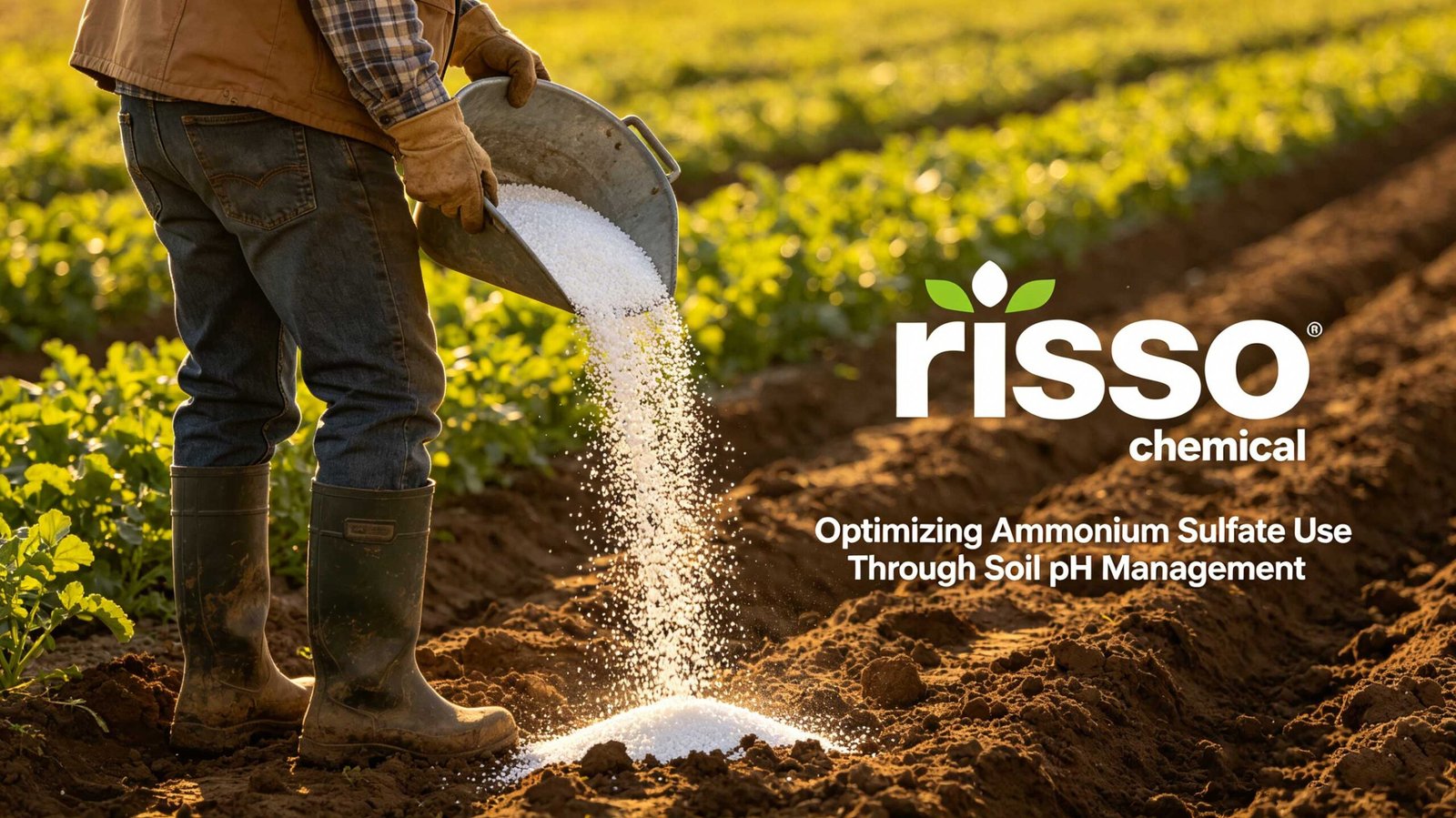
ToggleOptimizing Ammonium Sulfate Use Through Soil pH Management
Soil pH fundamentally controls how fertilizers behave and how well plants can access nutrients. For ammonium sulfate—a dual nitrogen and sulfur fertilizer known for its acidifying nature—soil pH doesn’t just influence effectiveness; it dictates the very mechanisms of nutrient release, transformation, and potential loss. From strongly acidic to highly alkaline conditions, the performance and environmental footprint of this fertilizer change dramatically.
This guide details the science behind the ammonium sulfate–pH interaction and delivers actionable strategies for growers. By matching application methods to specific soil pH levels, it is possible to significantly boost nitrogen use efficiency, minimize wasteful ammonia loss, and build a more sustainable fertilization program, drawing on the agronomic expertise of partners like Risso Chemical.
1. The Critical Link Between Soil Acidity and Fertilizer Function
Soil pH is a master variable in soil chemistry, directly affecting microbial populations, nutrient solubility, and chemical reaction pathways. For a fertilizer like ammonium sulfate, pH determines the fate of its ammonium nitrogen. In acidic conditions, the ammonium ion is stable, but the associated release of hydrogen ions can exacerbate acidity. In alkaline settings, the same ammonium can rapidly convert to gaseous ammonia and escape into the air. Understanding this spectrum of behavior is the first step toward intelligent, site-specific management.
2. The Chemistry of Ammonium Sulfate in the Soil Environment
Upon dissolution, ammonium sulfate dissociates into ammonium (NH₄⁺) and sulfate (SO₄²⁻) ions. The subsequent microbial-driven conversion of ammonium to nitrate (nitrification) is the process that releases acidity (H⁺ ions). This inherent acid-forming potential is why ammonium sulfate is termed a “physiologically acidic” fertilizer. This characteristic is a powerful tool for correcting alkaline soil pH but a significant risk factor in soils that are already acidic, requiring careful management to prevent detrimental drops in pH.
3. Tailored Application Strategies by Soil pH Category
A. For Acidic Soils (pH below 6.5)
In these soils, the acidifying effect is a primary concern. Unmanaged use can accelerate soil acidification, potentially mobilizing toxic levels of aluminum and manganese, which stunt root growth.
-
Recommendations: Employ ammonium sulfate strategically as a supplemental source of N and S, not the primary nitrogen workhorse. Integrate regular lime applications to counteract acidity. Consider blending with or rotating to nitrate-based fertilizers (like calcium nitrate) which have a neutralizing effect, to maintain a healthier pH balance for the long term.
B. For Neutral Soils (pH 6.5 – 7.5)
This is the optimal window for ammonium sulfate performance. The soil’s natural buffering capacity moderates pH shifts, allowing for efficient nitrification and stable nutrient availability with minimal volatility risk.
-
Recommendations: Standard application methods like broadcasting and incorporation are highly effective. Ammonium sulfate shines here for sulfur-loving crops such as canola, corn, and legumes. Risso Chemical often designs fertilization programs for this pH zone, where the fertilizer delivers maximum agronomic and economic return with predictable results.
C. For Alkaline/Calcareous Soils (pH above 7.5)
High pH poses the opposite challenge: volatilization. The equilibrium shifts toward ammonia gas (NH₃), leading to substantial nitrogen loss if the fertilizer is left on the surface.
-
Recommendations: Placement and incorporation are non-negotiable. Use banding or deep placement techniques to position fertilizer below the soil surface. Time applications just before irrigation or a significant rainfall to move the product into the root zone. Avoid top-dressing during hot, dry, or windy periods. Here, ammonium sulfate serves a dual purpose: providing nutrients and gently helping to lower the soil pH toward a more neutral, productive range.
4. Maximizing Efficiency and Curbing Nitrogen Loss
The relationship between pH and nitrogen use efficiency (NUE) is inverse when it comes to ammonia loss. As pH increases, so does the potential for gaseous loss of N from ammonium-based fertilizers. Therefore, the core management goal in alkaline soils is to physically prevent this loss through placement and water management. In acidic soils, the goal shifts to preventing excessive acidification that would lock up nutrients and harm soil biology. Both pathways lead to wasted fertilizer and reduced crop uptake if not managed correctly.
5. Implementing a pH-Aware Management Plan
A successful strategy is built on knowledge and adaptation:
-
Test Annually: Begin every season with a current soil test to know your exact pH and baseline nutrient levels.
-
Rate Appropriately: Adjust ammonium sulfate application rates based on crop need, yield goal, and the soil’s inherent sulfur-supplying power.
-
Time and Place Correctly: Let soil pH guide your method. Incorporate in high-pH soils; be prepared to lime in chronically low-pH soils.
-
Monitor Trends: Keep records of soil pH over seasons to identify long-term acidification trends from ammonium product use, allowing for proactive correction.
6. Conclusion: Precision Nutrition Through pH Understanding
Ammonium sulfate is a potent and valuable fertilizer, but its benefits are fully unlocked only when application is harmonized with soil chemistry. By adopting a pH-sensitive management approach, growers transform a simple input into a precise tool—enhancing crop nutrition, protecting the soil resource, and improving the bottom line.
Risso Chemical provides the high-quality ammonium sulfate and the agronomic support to help implement these tailored strategies, promoting productive and sustainable farming across diverse global landscapes.
Frequently Asked Questions (FAQs)
For most crops, application at or before planting is optimal. This provides readily available sulfur and nitrogen during early vegetative growth, when many crops have a critical demand for these nutrients. Side-dressing can also be effective if incorporated.
Yes, with prolonged and exclusive use. The nitrification process releases acidity. The rate of acidification depends on the initial soil pH, buffering capacity, and application rate. Regular soil testing is essential to monitor this change.
Its key advantages are: 1) Supply of both nitrogen and readily available sulfur in a single product; 2) Lower volatility potential than urea on surface applications (when incorporated, urea’s loss is higher); 3) Stability during handling and storage.
Without pH management, continuous use will lower soil pH, which can eventually reduce the availability of other nutrients like phosphorus and molybdenum, and increase availability of potentially toxic elements. This is managed through routine soil testing and liming.
Yes, it is an excellent and rapid solution for sulfur-deficient soils. The sulfate ion is immediately available for plant uptake, making it a reliable choice for correcting visible sulfur deficiency symptoms during the growing season.
-
Sale!
- Select options This product has multiple variants. The options may be chosen on the product page
¥71.49 – ¥80.56Price range: ¥71.49 through ¥80.56Rated 0 out of 5Ammonium Sulphate Nitrate (ASN) 26-0-0 Granular Fertilizer, High Nitrogen & Sulfur Fertilizer for Vegetables, Lawn, Pasture, Crops, 1.5kg Bag
-
Sale!
- Select options This product has multiple variants. The options may be chosen on the product page
¥90.90 – ¥91.90Price range: ¥90.90 through ¥91.90Rated 0 out of 5High Quality NPK Chlorine-based Balanced Formula Fertilizer, Granular 15-15-15 16-16-16 Compound Plant Food for Rice, Wheat, Corn, Cereal Crops
-
Sale!
- Select options This product has multiple variants. The options may be chosen on the product page
¥90.90 – ¥91.90Price range: ¥90.90 through ¥91.90Rated 0 out of 5NPK 15-15-15 Granular Compound Fertilizer, All Purpose Plant Food for Vegetables, Fruits, Flowers, Lawns and Crops