
Explore Trends, Innovations, and Achievements at HengZe Steel
Steel Grade Guide: Classification, Standards & Applications
- Industry News
- September 25, 2022
- 8:04 am
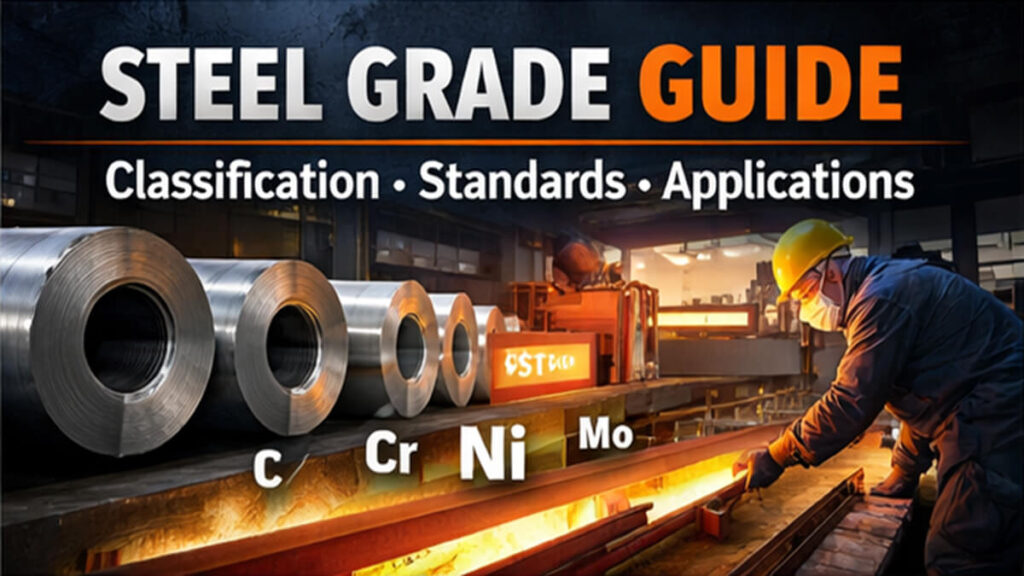
In the global steel industry, Steel Grade is the fundamental reference used to define material performance, quality consistency, and application suitability. From structural construction and infrastructure projects to steel coil processing, automotive manufacturing, and industrial equipment, selecting the correct steel grade is essential for ensuring safety, durability, and cost efficiency.
At Hengze Steel, we work closely with engineers, fabricators, and global buyers to supply steel products that strictly comply with international steel grade standards, helping customers achieve stable performance and long-term reliability in real-world applications.
This in-depth guide explains what steel grade means, how steel grades are classified, the differences between international steel grade standards, and how professionals can choose the right steel grade for specific applications.
Table of Contents
- 1️⃣ What Is Steel Grade?1️⃣ What Is Steel Grade?
- 2️⃣ Why Steel Grade Is Critical in Material Selection2️⃣ Why Steel Grade Is Critical in Material Selection
- 3️⃣ Key Factors That Define a Steel Grade3️⃣ Key Factors That Define a Steel Grade
- 4️⃣ Steel Grade Classification Systems Explained4️⃣ Steel Grade Classification Systems Explained
- 5️⃣ Common Steel Grades and Practical Applications5️⃣ Common Steel Grades and Practical Applications
- 6️⃣ Overview of International Steel Grade Standards6️⃣ Overview of International Steel Grade Standards
- 7️⃣ How to Choose the Right Steel Grade for Your Project7️⃣ How to Choose the Right Steel Grade for Your Project
- 8️⃣ Steel Grade Comparison and Interchangeability8️⃣ Steel Grade Comparison and Interchangeability
- 9️⃣ Final Thoughts Best Practices in Steel Grade Selection9️⃣ Final Thoughts Best Practices in Steel Grade Selection
1️⃣ What Is Steel Grade?
A Steel Grade is a standardized designation that defines steel according to its chemical composition, mechanical properties, and intended service conditions. Each steel grade represents a controlled balance of strength, ductility, hardness, weldability, and corrosion resistance.
In practical terms, steel grade selection determines whether a material is suitable for structural frameworks, galvanized steel coils, roofing sheets, automotive components, pressure vessels, or precision machinery. Using the correct steel grade ensures predictable performance, compliance with international specifications, and long-term reliability throughout the product lifecycle.
2️⃣ Why Steel Grade Is Critical in Material Selection
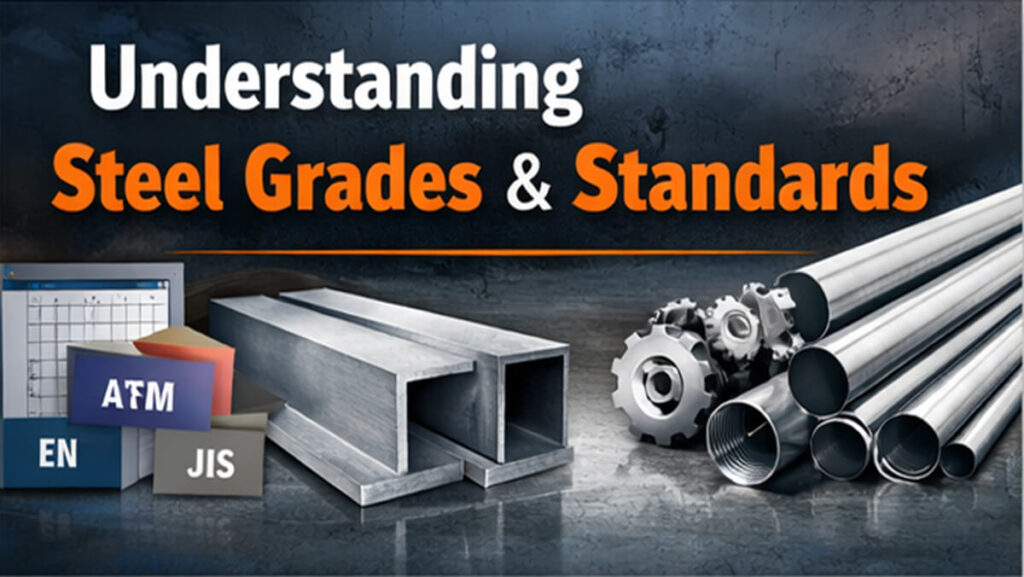
Steel grades are not simply naming conventions—they are the foundation of engineering safety, production efficiency, and quality control.
Correct steel grade selection helps to:
Ensure structural integrity and load-bearing safety
Optimize forming, welding, coating, and machining processes
Reduce material failure, rework, and production waste
Meet project specifications and international compliance requirements
Balance performance, durability, and total lifecycle cost
For manufacturers and steel buyers, misunderstanding steel grade requirements is one of the most common causes of material mismatch and application failure.
3️⃣ Key Factors That Define a Steel Grade
Steel grades are defined by measurable and internationally standardized parameters.
🔹 Chemical Composition
The controlled content of carbon and alloying elements—such as manganese, silicon, chromium, nickel, molybdenum, and aluminum—directly determines steel behavior.
Low-carbon steel grades offer excellent formability and weldability
Alloy steel grades provide higher strength, fatigue resistance, and wear performance
Stainless steel grades rely on chromium content for corrosion resistance
Chemical composition is the foundation of steel grade classification and interchangeability.
🔹 Mechanical Properties
Steel grade standards define minimum mechanical performance values, including:
Yield strength
Tensile strength
Elongation
Impact toughness
These indicators are critical when selecting steel grades for structural construction, heavy machinery, or load-bearing applications where safety margins are non-negotiable.
🔹 Processing and Application Requirements
Certain steel grades are specifically designed for:
Cold forming and deep drawing
Continuous steel coil production and slitting
High-temperature or pressure service
Matching the steel grade to the processing route ensures production stability and consistent end-product quality.
4️⃣ Steel Grade Classification Systems Explained
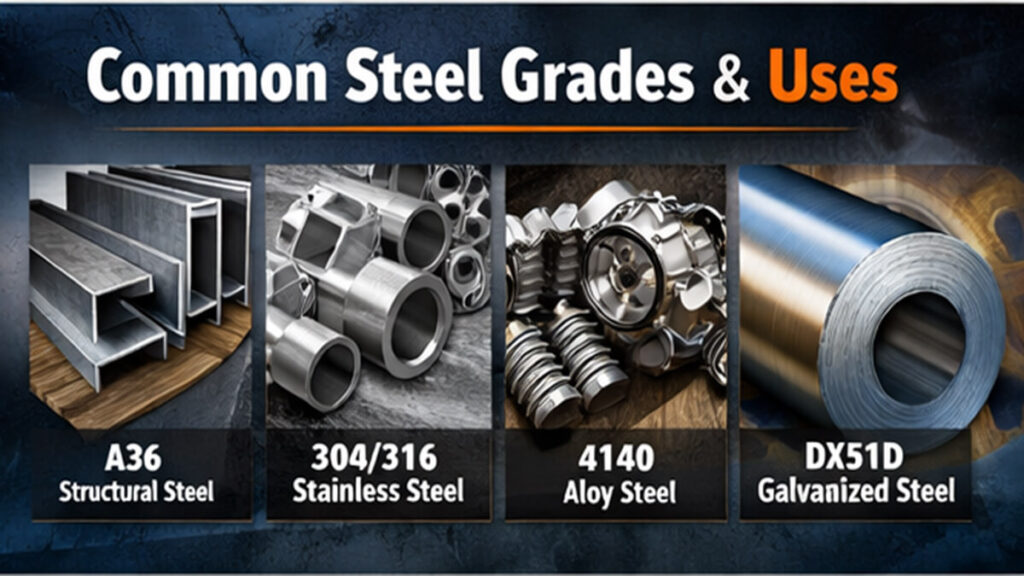
Steel grades are classified differently across regions, but the technical principles remain consistent worldwide.
4.1 Carbon Steel Grades
Carbon steel grades are generally divided into:
Low carbon steel (mild steel)
Medium carbon steel
High carbon steel
Low-carbon steel grades are widely used in galvanized steel coils, corrugated roofing sheets, structural components, and general fabrication, thanks to their excellent ductility and cost efficiency.
4.2 Alloy Steel Grades
Alloy steel grades contain additional elements such as chromium, molybdenum, or nickel. These grades offer improved mechanical strength, fatigue resistance, and thermal stability, making them ideal for automotive parts, shafts, gears, and high-load mechanical components.
4.3 Stainless Steel Grades
Stainless steel grades—such as 304 and 316—are characterized by superior corrosion resistance. They are commonly used in food processing equipment, chemical plants, medical devices, and marine environments.
4.4 Tool Steel Grades
Tool steels are engineered for extreme hardness and wear resistance and are used in cutting tools, dies, molds, and high-stress industrial tooling.
5️⃣ Common Steel Grades and Practical Applications
Understanding how steel grades perform in real-world applications helps buyers make accurate and efficient decisions.
ASTM A36 Steel Grade – Structural beams, bridges, and building frames
S235 / S355 Steel Grades – European structural steel for construction projects
DX51D / DX52D Steel Grades – Galvanized steel coils for roofing and cladding systems
SAE 1018 / 1020 – General engineering and machining applications
4140 / 4340 Alloy Steel Grades – Automotive and mechanical components
304 / 316 Stainless Steel Grades – Corrosion-sensitive environments
As a professional steel supplier, Hengze Steel supports customers in matching steel grades precisely to application requirements, reducing risk and improving project efficiency.
6️⃣ Overview of International Steel Grade Standards
7️⃣ How to Choose the Right Steel Grade for Your Project
Steel grades are governed by several major international standards organizations:
ASTM Steel Grades – Widely used in North America for construction and manufacturing
AISI / SAE Steel Grades – Focus on chemical composition and alloy classification
EN Steel Grades – European standards emphasizing structural performance
JIS Steel Grades – Common in automotive and industrial manufacturing
GB / ISO Steel Grades – Chinese and international reference systems
Although naming conventions differ, many steel grades have equivalent or comparable alternatives across standards, enabling global sourcing and technical substitution.
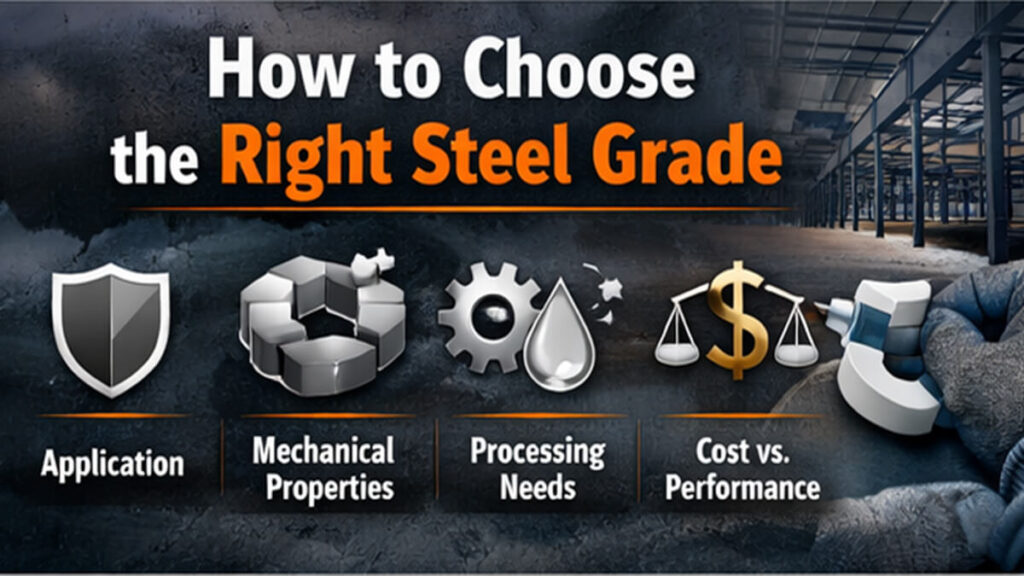
Selecting the correct steel grade requires a structured and engineering-driven approach:
✔ Define the Service Environment
Exposure to corrosion, temperature fluctuations, mechanical load, or weather conditions directly affects steel grade selection.
✔ Match Mechanical Requirements
Structural applications require guaranteed yield strength, while forming applications benefit from softer steel grades with higher elongation.
✔ Consider Processing Compatibility
If the steel will be galvanized, coated, cold-formed, or slit into coils, the steel grade must be fully compatible with continuous processing lines.
✔ Balance Performance and Cost
The most suitable steel grade is not always the highest-strength grade, but the one that best fits the application and budget.
8️⃣ Steel Grade Comparison and Interchangeability
Because steel is traded globally, understanding steel grade equivalence is essential. Many international standards define grades with similar chemical and mechanical properties, allowing substitution when verified correctly.
Accurate steel grade comparison ensures:
Stable performance across supply chains
Compliance with project and client specifications
Reduced procurement delays and technical risks
9️⃣ Final Thoughts: Best Practices in Steel Grade Selection
Steel Grade is more than a technical label—it is the foundation of safe design, efficient manufacturing, and long-term material performance.
A thorough understanding of steel grade classification, standards, and applications enables engineers and buyers to:
Select materials with confidence
Avoid costly errors and over-specification
Optimize quality, durability, and cost efficiency
For construction materials, steel coils, and industrial manufacturing, choosing the correct steel grade is the first and most critical decision.
With professional support and strict quality control, Hengze Steel helps global customers source the right steel grade for every application with confidence.
Trending News
What to Expect When You Contact Us
Fast Response – Replies within 12 hours
Tailored Solutions – Based on your needs and industry
Full Support – From products to technical and market guidance