Explore Trends, Innovations, and Achievements at HengZe Steel
Coated Steel Coils: Types, Properties & Industrial Applications
- Industry News
- January 8, 2026
- 6:06 am
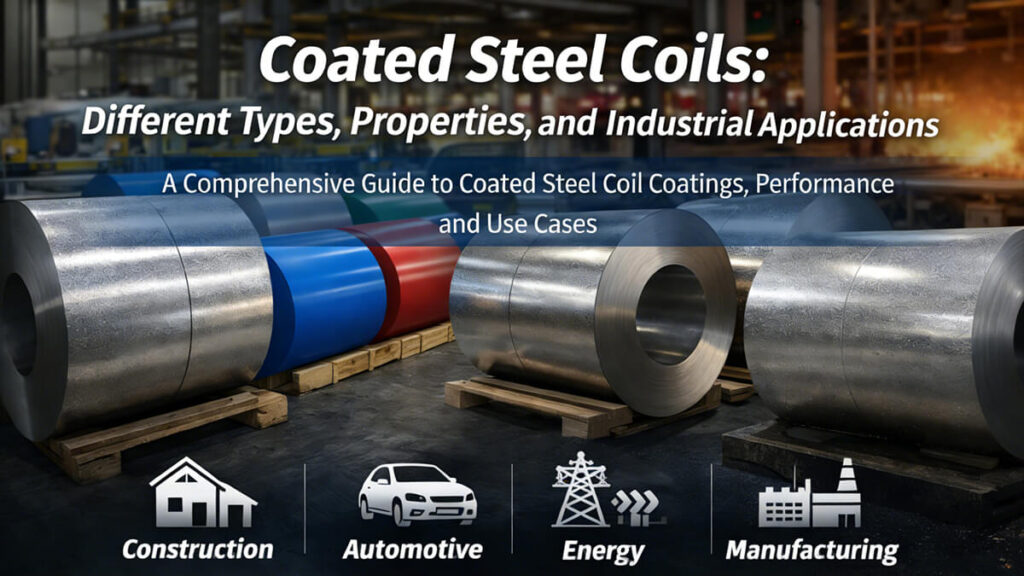
As a professional coated steel coil manufacturer and global supplier, Hengze Steel provides a full range of high-quality coated steel coils designed for construction, automotive, energy, and industrial applications worldwide.
Coated steel coils are essential materials widely used across construction, automotive manufacturing, energy infrastructure, home appliances, and industrial fabrication. By applying metallic or organic coatings to cold-rolled or hot-rolled steel substrates, coated steel coils significantly enhance corrosion resistance, mechanical durability, surface stability, and long-term performance.
Understanding the different types of coated steel coils and their specific coating systems is critical when selecting materials for projects exposed to varying environmental conditions, mechanical stresses, and service life requirements.
Table of Contents
- 1️⃣ What Are Coated Steel Coils1️⃣ What Are Coated Steel Coils
- 2️⃣ Main Types of Coated Steel Coils2️⃣ Main Types of Coated Steel Coils
- 3️⃣ Key Factors When Choosing Coated Steel Coils3️⃣ Key Factors When Choosing Coated Steel Coils
- 4️⃣ Conclusion4️⃣ Conclusion
1️⃣ What Are Coated Steel Coils
Coated steel coils are flat-rolled steel products that undergo surface treatment through hot-dip coating, electroplating, or continuous coil coating processes. These coatings act as protective barriers, preventing oxidation and corrosion while also improving formability, paint adhesion, and surface aesthetics.
Depending on coating composition and thickness, coated steel coils are engineered to perform reliably in coastal regions, high-humidity climates, industrial atmospheres, or high-temperature environments, making them indispensable within modern steel supply chains.2️⃣ Main Types of Coated Steel Coils
2.1 Galvanized Steel Coil (GI)
Galvanized steel coils are produced by immersing steel into molten zinc, forming a continuous zinc layer that protects the base metal through sacrificial corrosion protection.
Key advantages:
Cost-effective corrosion resistance for general environments
Excellent forming and welding performance
Available under international standards such as ASTM A653 and EN 10346
Common applications include roofing sheets, steel structures, ventilation systems, light framing, and general fabrication.
2.2 Aluzinc / Galvalume Steel Coil (AZ)
Aluzinc steel coils (Galvalume) feature a coating composed of approximately 55% aluminum, 43.4% zinc, and 1.6% silicon, offering superior corrosion resistance compared to conventional galvanized steel.
Performance highlights:
Outstanding long-term corrosion resistance
High thermal reflectivity and heat resistance
Extended service life in aggressive environments
AZ-coated steel coils are widely used in industrial roofing, wall cladding, agricultural buildings, and projects where AZ coating vs GI coating performance is a key consideration.
2.3 Prepainted Steel Coil (PPGI / PPGL)
Prepainted steel coils are produced by applying organic paint systems onto galvanized (PPGI) or Aluzinc (PPGL) substrates using continuous coil coating technology.
Understanding the difference between PPGI and PPGL steel coils is essential, as PPGL generally provides enhanced corrosion protection due to its Al-Zn base coating.
Key benefits:
Excellent weather resistance and color retention
Decorative appearance combined with long-term protection
Available coating systems: PE, SMP, HDP, and PVDF
PPGI and PPGL coils are widely used in roofing panels, architectural façades, home appliances, sandwich panels, and industrial enclosures.
2.4 Electro-Galvanized Steel Coil (EG)
Electro-galvanized steel coils are manufactured using electroplating, allowing precise control of zinc thickness and exceptional surface uniformity.
Key characteristics:
Smooth, clean surface finish
Superior paint adhesion
Lower corrosion resistance compared to hot-dip galvanized steel
Typical applications include automotive body panels, office equipment, and precision-formed components.
2.5 Aluminized Steel Coil (AS)
Aluminized steel coils are coated with aluminum-based alloys, providing excellent resistance to oxidation and high-temperature corrosion.
Technical advantages:
Outstanding thermal stability
Strong resistance to sulfur-containing environments
Stable performance under extreme heat
Common applications include automotive exhaust systems, heat shields, furnaces, and thermal processing equipment.
2.6 Tinplate Steel Coil
Tinplate steel coils consist of steel coated with a thin layer of tin, offering corrosion resistance combined with food-safe properties.
Key features:
Excellent formability and solderability
Smooth surface suitable for printing and lacquering
Compliance with food and beverage packaging standards
Tinplate is widely used for food cans, aerosol containers, and chemical packaging.
2.7 Zinc-Aluminum-Magnesium Coated Steel Coil (ZAM)
ZAM coated steel coils incorporate magnesium into zinc-aluminum systems, delivering significantly enhanced corrosion resistance.
Key performance advantages:
Exceptional edge corrosion protection
Superior durability in marine and industrial environments
Reduced zinc consumption and extended service life
Zinc aluminum magnesium coated steel is increasingly used in solar mounting systems, agricultural facilities, infrastructure projects, and outdoor steel frameworks.
2.8 Galvannealed Steel Coil (ZF)
Galvannealed steel coils are produced by annealing hot-dip galvanized steel, forming a zinc-iron alloy layer with improved surface characteristics.
Benefits include:
Excellent paint adhesion
Good weldability and dimensional stability
Balanced corrosion performance
ZF-coated steel is widely used in automotive body structures and painted components.
2.9 Galfan Coated Steel Coil (ZA)
Galfan steel coils feature a zinc-aluminum alloy coating (typically around 5% aluminum), offering enhanced corrosion resistance compared to traditional GI.
Key advantages:
Uniform coating structure
Improved corrosion performance
Good forming and joining properties
3️⃣ Key Factors When Choosing Coated Steel Coils
When selecting the appropriate coated steel coil, consider the following factors:
Environmental exposure (coastal, industrial, rural)
Required service life and maintenance expectations
Processing requirements such as bending, welding, or painting
Aesthetic and surface quality demands
For harsh outdoor environments, AZ or ZAM coated steel coils are often preferred, while PPGI and PPGL provide optimal solutions when both appearance and durability are critical.
Midway through material selection, many buyers rely on experienced suppliers like Hengze Steel to recommend suitable coating systems based on application, climate, and lifecycle cost considerations.4️⃣ Conclusion
Coated steel coils offer a wide range of coating technologies designed to meet diverse industrial and environmental demands. From galvanized and Aluzinc steel coils to advanced zinc aluminum magnesium coatings, each type provides distinct performance advantages.
By understanding the types of coated steel coils, their properties, and real-world applications, engineers and buyers can make informed material choices that improve structural reliability, reduce long-term costs, and ensure consistent performance.
As a trusted global supplier, Hengze Steel remains committed to delivering high-performance coated steel coil solutions tailored to international standards and demanding applications.
Trending News
What to Expect When You Contact Us
Fast Response – Replies within 12 hours
Tailored Solutions – Based on your needs and industry
Full Support – From products to technical and market guidance